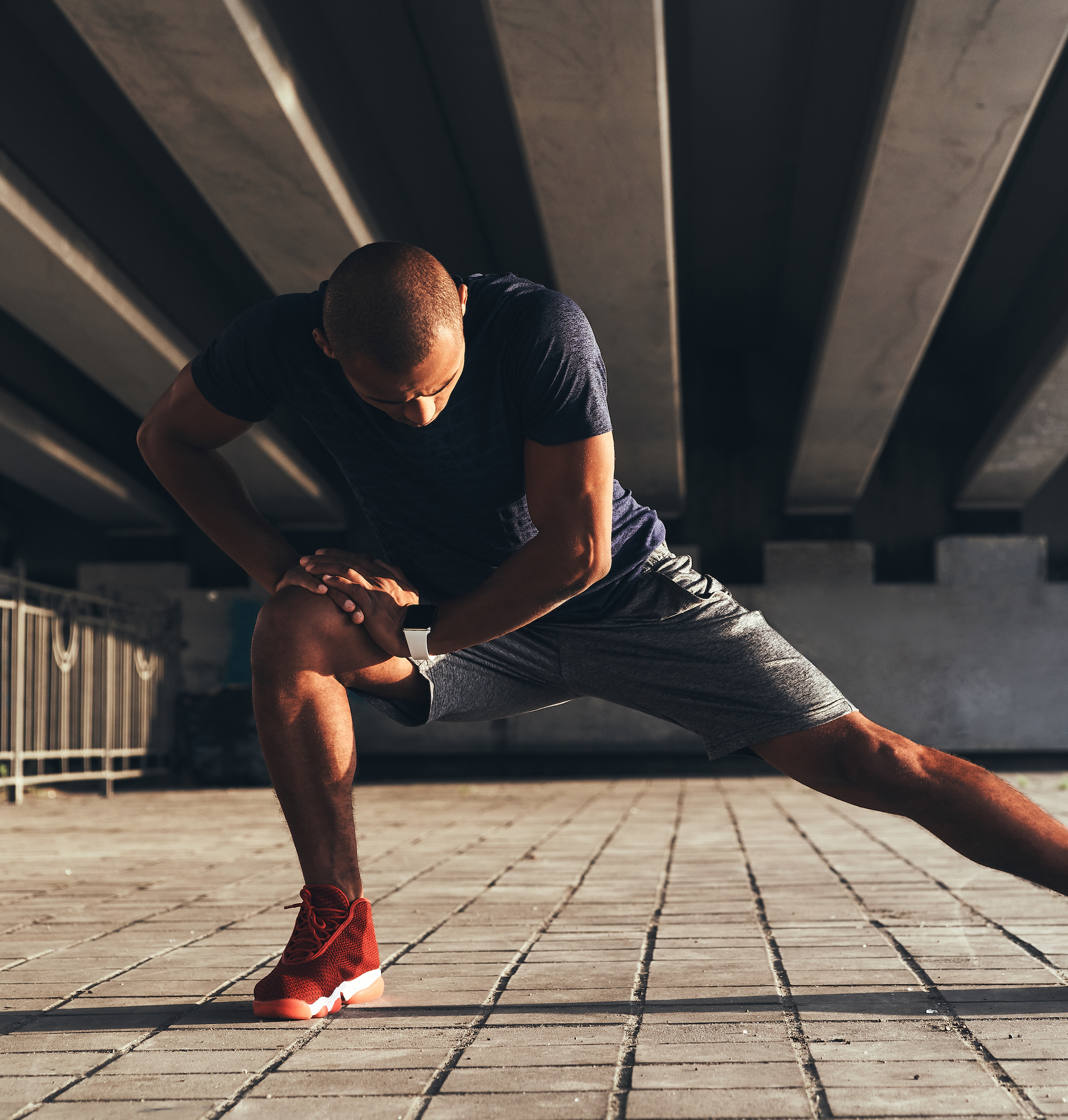
There’s no question that stretching feels good – at least after we’ve done it. But why is that; what has actually changed? And will stretching have a lasting effect on how flexible we are?
Short-term (immediate) increases in flexibility are probably due to viscoelastic changes in the muscle, or put more simply, a change in the relationship between the fluid/gel content of the muscle to the other stuff that comprises muscle – collagen, elastin, and muscle cells. That is, when we stretch a muscle we increase the pressure in the muscle compartment (muscle surrounded by connective tissue, or fascia) and fluid gets squeezed out. We immediately feel less stiff. And if we wanted to measure the stiffness in the muscle (stiffness being the force required to stretch the muscle), it would indeed be less stiff. However, viscoelastic changes are short-lived and tend not to result in long-term improvements in flexibility.
If we do regular stretching, then something different happens. It’s not that our muscles get longer, or even less stiff; rather our tolerance to stretch increases. What does that mean? It means that the regular signals from our proprioceptors on being stretched – joint, muscle, tendon – to the neurological system/brain stimulates a change (neuroplasticity) whereby the muscle is enabled to elongate more. Effectively, the control centre allows more movement.
Why is this useful to know?
Because one round of stretching (treatment, yoga class) is reducing stiffness largely because of fluid changes in the muscle – rather than changing anything in our nervous system – it will tend not to have a lasting effect. Having said that, we may still get some lasting benefit if there is carryover of the short term gain in flexibility to our daily activities or workouts, which means that we are effectively continuing to move/stretch our muscles more than previously.
The implication being that we need to stretch regularly so that changes are made in our nervous system/brain that allow muscles to lengthen more. It is this regular input to the nervous system that creates long-term change.
The upshot: stretch/move/do exercises little and often if you want to improve flexibility.
Image by Jonathon Sautter from Pixabay